

Commercial Fiber Optic Contractor and Installer in Pennsylvania
KIT Communications is a commercial fiber optic contractor and installer serving central and eastern Pennsylvania from our Lebanon headquarters. Service coverage runs from Chambersburg through the Lehigh Valley, with drive-time coverage across the Susquehanna Valley, the I-81 freight spine, and the I-78 distribution corridor. As a Pennsylvania low voltage contractor in business since 1999, KIT handles fiber optic cable installation, fusion splicing, and termination — packaged with a larger structured cabling project, or as a standalone scope for backbone-only and inter-building work.
Fiber is the part of the cable plant where distance, electrical noise, and bandwidth headroom rule out copper — the run between two buildings, the campus backbone, the high-density data-center spine. 3,400+ commercial projects since 2020, most of it repeat work, averaging over five projects per client across KIT’s 25+ years. Every fiber run is tested for end-to-end light loss before closeout.
Single-Mode and Multimode Fiber Optic Cable

Single-mode (OS2). The choice for inter-building backbone, campus links, and any run that needs distance. Single-mode carries further and holds bandwidth headroom for years of network upgrades on the same glass.
Multimode (OM3, OM4, OM5). Used for in-building backbone, data-center switch-to-switch links, and equipment-room interconnects where runs are short and the optics are cheaper than single-mode.
Fiber is specified by where it runs and what it has to survive: indoor-rated and outdoor-rated jackets, plenum and riser ratings to match building code, and armored cable where rodents, crush risk, or direct-bury conditions call for it. KIT helps the client land on the right fiber type and count, so the backbone is sized to what the building needs.
Fusion Splicing, Termination, and Light-Loss Testing
A clean splice and a verified light budget keep a link running for a decade.
Fusion splicing for permanent low-loss joints on backbone and OSP runs, mechanical splicing, and field termination and connectorization for patch fields and equipment connections.
End-face inspection and cleaning on every connection.
End-to-end light-loss testing on every run to verify the link meets its performance budget before closeout, documented in the closeout package.
Outside Plant (OSP) Fiber: Aerial, Underground, and Campus Backbone
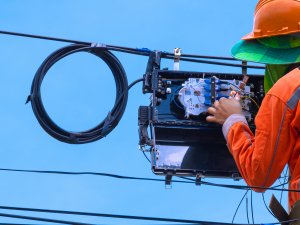
KIT installs outside plant fiber — the runs that leave the building — in-house.
Aerial fiber lashed or self-supporting on existing pole lines, underground fiber direct-buried or pulled through conduit, and campus duct-bank systems that tie a dozen buildings back to a central node.
OSP scope ranges from a single inter-building run across a parking lot to multi-building campus backbones — school district campuses, hospital and senior-living campuses, and institutional campuses across the Susquehanna Valley and the Lehigh Valley.
Outside plant is where formal design has to happen before anyone digs or climbs. KIT’s OSP design lead holds both the BICSI RCDD and BICSI Outside Plant Designer credentials, and the pathway design, splice budgets, and conduit sizing happen in-house ahead of the install. Both credentials are verifiable through BICSI’s public directory.
Data Center and High-Density Backbone Fiber
For the fiber inside the data center — pre-terminated MPO/MTP trunks and cassettes for high-density backbone, switch-to-switch links, and fiber-to-the-desk runs.
When the project is a full computer-room or server-room build — racks, cabinets, pathways, patch fields, and power coordination — see KIT’s data center and server room cabling page for that scope.
Fiber Optic Repair and Restoration
KIT troubleshoots, repairs, and restores damaged fiber optic cable on buried, aerial, and in-building runs. Fault-location testing pinpoints the break, measures mid-span splice loss, and reports the distance to the fault. KIT then repairs and re-certifies the link.
Industries We Run Fiber For
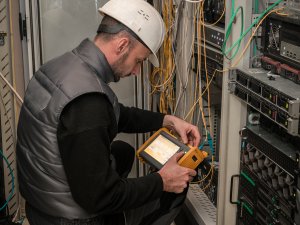
K-12 Schools and School Districts. Inter-building fiber between buildings on a campus, backbone from the district tech office out to each school, and the OSP runs that tie an athletic complex or a satellite building back to the network. Districts across twelve counties from Allentown to York; KIT holds PEPPM cooperative purchasing contracts for school fiber work.
Healthcare and Senior-Living Campuses. Campus backbone between hospital buildings and senior-living facilities, redundant fiber paths where a single cut can’t be allowed to isolate a building, and re-cabling older plants to current backbone standards. Coverage reaches campuses across the Susquehanna Valley health systems.
Distribution Centers and Warehouses. Single-mode backbone the length of a high-bay building, fiber to remote IDFs in the racking, and inter-building links across a multi-building logistics site. Coverage follows the I-81 and I-78 freight corridors from Carlisle to the Lehigh Valley.
Manufacturing and Food Processing. Fiber where copper can’t go — long plant-floor runs, electrically noisy environments, and links between separated production buildings. Coverage reaches plants from the York County manufacturing base through Hanover’s snack-food cluster, the Berks County manufacturing belt around Reading, and into the Lehigh Valley.
Government and Cooperative Buyers. KIT holds COSTARS, PEPPM, and TIPS cooperative purchasing agreements for municipalities, county campuses, and state and federal agencies.
Start a Fiber Project
New project requests begin with a phone or email to our Sales team. Contact KIT Sales for a site survey and a written proposal.
Why KIT for Fiber Optic
A Pennsylvania low voltage contractor since 1999. The fiber backbone carries the rest of the building — security cameras, access control, WiFi, phone systems, and the copper structured cabling at the edge. KIT installs all of it.
OSP design in-house, not subbed out. KIT carries two BICSI Registered Communications Distribution Designer credentials (RCDD #120421 and RCDD #271784), the latter also holding the BICSI Outside Plant Designer credential — both verifiable through BICSI’s public directory. Outside plant and complex campus backbone are exactly the fiber work that needs a credentialed designer, and that design happens in-house before the crew shows up — not handed to a subcontractor.
Splicing and testing are KIT’s own crew. The same people who pull the fiber splice it and certify it, so accountability for the light budget doesn’t change hands mid-project.
Cutover scheduled around the facility. A backbone cut-in on a live campus has its own logistics. KIT works with the client to plan a cutover that fits how the building actually runs.
Frequently Asked Questions
Single-mode (OS2) for inter-building backbone, campus links, and long-distance runs, and multimode (OM3, OM4, OM5) for in-building backbone, data-center switch-to-switch links, and equipment-room interconnects. KIT also installs outside plant fiber (aerial and underground) and pre-terminated MPO/MTP trunks for data centers.
Yes. KIT performs fusion splicing, mechanical splicing where fusion is impractical, field termination and connectorization, and end-face inspection and cleaning. Every fiber run is tested for end-to-end light loss to verify the link meets its performance budget before closeout.
Yes. KIT installs aerial fiber (lashed or self-supporting on pole lines), underground fiber (direct-bury or conduit-pull), and campus duct-bank systems. KIT’s outside plant design lead holds both the BICSI RCDD and BICSI Outside Plant Designer credentials, so the pathway design, splice budgets, and conduit sizing happen in-house before the install crew arrives.
Yes. KIT locates the fault along a fiber run, re-splices breaks or replaces damaged sections, and re-certifies the link with end-to-end light-loss testing. Construction digs, rodent damage, and storm damage to aerial spans are the common reasons a building loses an inter-building link.
KIT serves the central and eastern Pennsylvania corridor from our Lebanon headquarters — Lancaster, Harrisburg, Lebanon, York, Reading, Allentown, Bethlehem, Easton, Carlisle, Chambersburg, Hershey, and Hanover.
Yes. KIT employs two BICSI Registered Communications Distribution Designers (RCDDs) — RCDD #120421 and RCDD #271784, the latter also holding the BICSI Outside Plant Designer credential. All fiber work follows BICSI and ANSI/TIA-568 standards.